Google Meridian vs. Meta Robyn – What’s Next for MMM?
🚨 Google Just Dropped a New MMM Tool


- Meridian is Google’s new open-source marketing mix model. Robyn is Meta’s.
- In our first test on a client account, Meridian was easier to run but harder to get right.
- Either way, your model is only as good as the spend and revenue data you feed it.
There’s a new player in the Triple M game. For years, Meta’s Robyn has been the go-to open source Marketing Mix Modeling (MMM) tool for marketers looking to measure the impact of their media spend. It’s been a valuable option for companies navigating the post-cookie world, offering a way to estimate effective value across channels without relying on user-level tracking.
Now, Google is in the picture with their newly released MMM. Meridian is Google’s first open-source MMM solution, designed to help brands measure their marketing performance across both online and offline channels. But how does it stack up against Robyn, and what does it mean for your marketing strategy?
We've had a brief play around with Meridian, and even tried to run it alongside a Robyn MMM for one of our clients. If I'm being honest, it seems easier to run but harder to get right. The basics of running the models are super simple, but that means there is less to experiment fiddling with to try and increase the accuracy of the models. That's just my initial view, and this might change with time. Here's what the documentation alludes to:
Meridian vs. Robyn: Key Differences
While both tools serve a similar purpose, their approach and functionality have some key differences.
| Google Meridian | Meta Robyn | |
|---|---|---|
| Who Built It? | Meta | |
| Coding Language | Python - coding experience required | R - coding experience required (Python version is in Beta) |
| Modelling Approach | Bayesian | Bayesian |
| Ease of Use | Can be run online using Google Colab, with easy-to-follow documentation | Requires RStudio Desktop app |
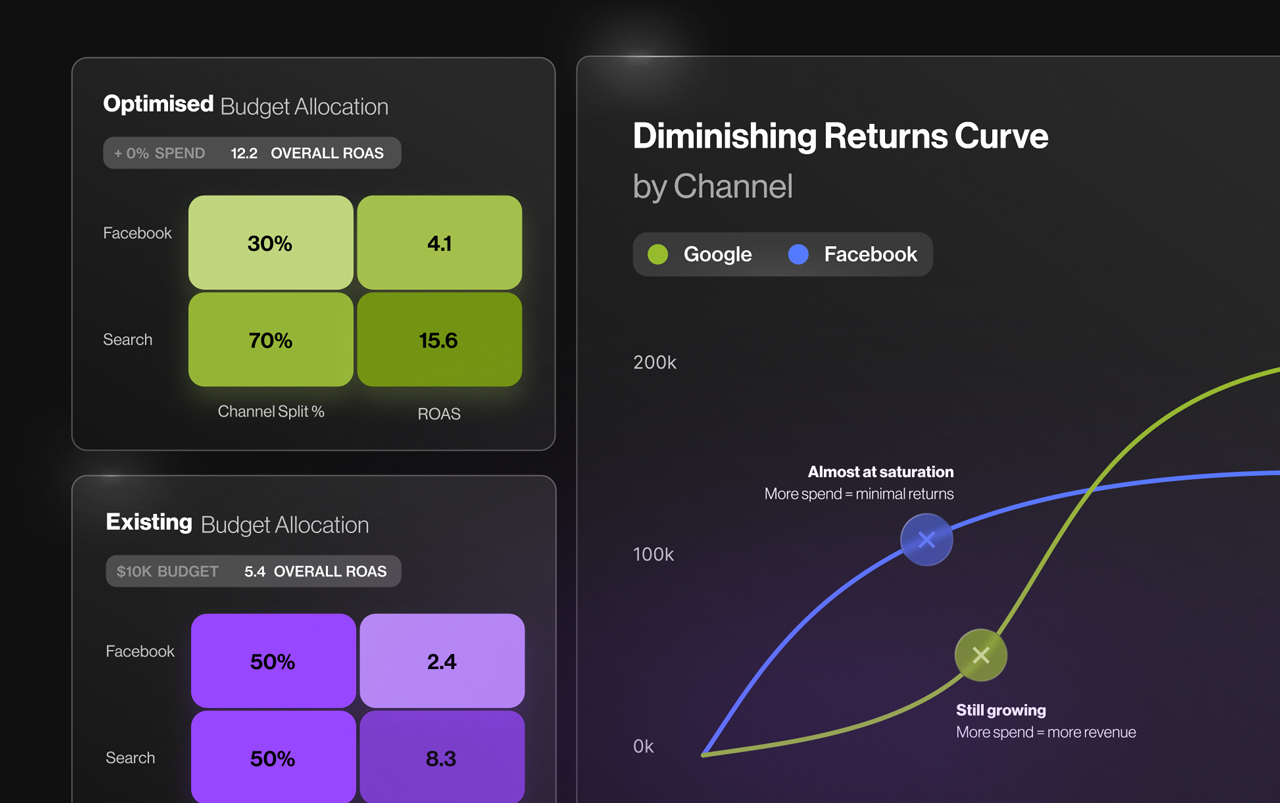
| Output Visualizations | Model Fit Charts, Channel Contribution Charts, ROI Charts, Response Charts, Adstock Decay Curves | Model Fit Charts, Channel Contribution Charts, ROI Charts, Response Charts, Adstock Decay Curves, Trend / Seasonality Decomposition |
| Output Optimizations | Optimized budget allocation, Optimal frequency | Optimized budget allocation |
*A Bayesian approach helps refine predictions by starting with past knowledge and updating it with new data. This makes it more flexible than traditional models, as it continuously learns and adapts to changes over time.
So, Which One Should You Use?
- If you’re already using Robyn and happy with it, Meridian doesn’t necessarily replace it but it’s worth testing.
- If you’re wanting a model that is easier to use, Meridian offers a modular approach that could be more adaptable.
- If you’re heavily invested in Google’s ecosystem (GA4, Google Ads, YouTube), Meridian is likely to offer a smoother integration.
- If your focus is paid social and you want MMM that’s geared toward media budget optimization, Robyn is still a solid option.
The reality?
There’s no one-size-fits-all answer. The best MMM approach for your business depends on your data, your goals, and how comfortable you are with statistical modeling.
What’s next?
Meridian is still new, and it will take time for the industry to adopt it and uncover its strengths and weaknesses. But one thing’s clear, MMM is becoming more accessible, and that’s a win for marketers looking to make smarter, data-driven decisions.
We’ll check your tracking and tell you what your data can and can’t prove.